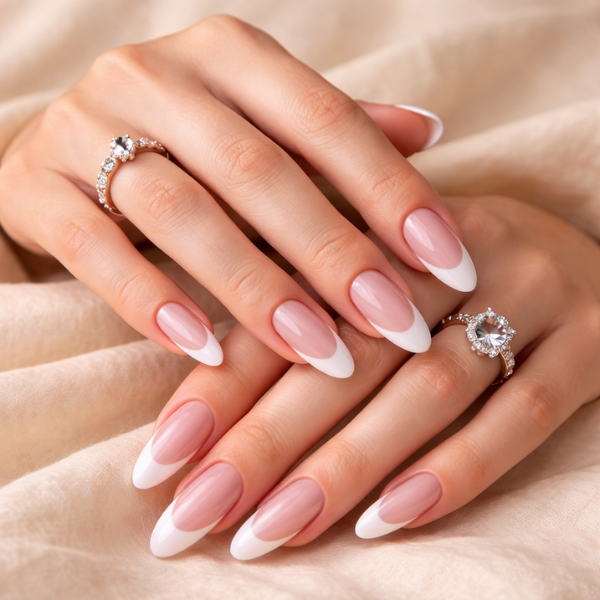
The original French manicure was never actually French. It was invented in Hollywood in the 1970s by Jeff Pink, founder of Orly, who created the look so film actresses could keep the same manicure across costume changes. Knowing that white french tip nails started as a practical solution for continuity rather than a Parisian beauty secret somehow makes me appreciate them more. This classic design has evolved dramatically since those studio lot days, and the modern versions are far more wearable than the thick, opaque tips we all remember from the early 2000s.

Why White French Tip Nails Remain Universally Flattering
Unlike trends that favor certain skin tones or nail shapes, the French manicure works because it mimics your natural nail. The sheer pink or nude base disappears into your nail bed while the white tip extends the visual line of your natural free edge. This creates an illusion of longer, healthier nails without the obvious artifice of a bold color.
The key is customization. The base shade should nearly match your nail bed, not your skin. Hold potential base colors against your bare nail, not your hand. Most people need a shade with more warmth than they expect. If your nail beds lean purple or blue, choose a base with peachy undertones to neutralize. For yellow-toned nail beds, a cooler pink works better.
I have watched the French tip cycle through trend reports for years. It disappeared around 2012, returned ironically in 2018, and now exists in a permanent state of reinvention. The current iteration favors thinner tips, sometimes barely a millimeter wide, applied to natural nail shapes rather than the squared-off acrylics of decades past. This subtle approach reads as polished rather than dated.
What most articles will not tell you is that the French manicure actually looks best slightly grown out. A few days after application, when the tip has moved just past the free edge, the proportions become more natural and less precise.
Choosing Your Base and White Polish Combination
The French manicure requires two polishes working together, and their interaction matters more than either shade alone. Your base coat, sheer color, white tip polish, and top coat all contribute to the final result.
For the sheer base, Essie Mademoiselle remains the industry standard for good reason. It applies evenly, dries quickly, and flatters most nail beds. If you run warmer, OPI Bubble Bath provides more peachy depth. For darker skin tones, Essie gel couture offers beautiful coverage without washing anyone out.

The white tip polish needs opacity and precision in equal measure. Thin formulas require multiple coats that increase the chance of smudging. I reach for Sally Hansen Insta-Dri in Whirlwind White when I want to finish quickly. For more careful application, Orly French Manicure White Tips offers a thin brush designed specifically for smile lines.
Here is my controversial opinion that professional nail techs might disagree with: pure white tips look dated on almost everyone. An off-white, ivory, or soft cream creates the same brightening effect without the stark contrast that screams 2004. China Glaze White on White photographs as white but reads as slightly warm in person.
How to Paint a Perfect Smile Line at Home
The smile line is where most DIY French manicures fail. Wobbly curves, uneven thickness, and visible brush strokes turn an elegant look into a frustrating mess. But the technique is learnable with the right approach.
First, forget about painting the curve in one stroke. That works for professionals with thousands of hours of practice. Instead, paint your smile line in three sections. Start at one side of your nail and stroke toward the center, stopping before you reach the apex. Repeat from the other side. Then connect the two lines at the center with a tiny bridging stroke.
Your brush angle determines everything. Hold it almost parallel to your nail surface rather than perpendicular. This gives you more control and creates thinner lines. Wipe most of the polish off your brush before you start. You want barely any product for the first pass.

French tip guides can help while you build muscle memory. Beetles French Manicure Tip Guides come in various curve depths. Apply them just below where you want your smile line, paint over the exposed tip, and peel away before the polish dries completely. The edge will be slightly less crisp than freehand painting, but far more consistent.
For cleanup, dip a small brush in pure acetone and trace along the smile line to sharpen any wobbly edges. A pointed brush works better than a flat one here. The Beetles Nail Art Brushes set includes several sizes perfect for this. Clean up before applying top coat, or you will seal in your mistakes.
Modern Variations on the Classic White French Tip
The traditional French tip has spawned dozens of variations, each putting a contemporary spin on the original concept. Micro French tips use an almost imperceptibly thin white line, sometimes only half a millimeter wide. This version requires steady hands and good eyesight but creates an incredibly sophisticated effect.
Double French tips add a second line of color, usually in nude or another soft white, creating depth without competing with the classic palette. Side French tips angle the smile line diagonally across the nail rather than following the natural curve. This geometric interpretation feels modern without abandoning the white tip entirely.

Reverse French tips, sometimes called half-moon manicures, place the white at the lunula rather than the tip. This Art Deco style flatters shorter nails because it does not require any free edge length.
For those who want to experiment with white french tip nails without committing to the technique, press-on options have improved dramatically. KISS Salon Acrylic French comes pre-painted with a believable smile line and lasts up to a week with proper application. BTArtbox Press On Nails in French Tip style offers a more natural curve that suits oval and almond shapes.
Making Your White French Tip Nails Last
Longevity depends on preparation more than product quality. Your nails need to be completely clean and dry before polish touches them. Even natural oils from your fingers will create separation between the nail plate and base coat within days. Swipe each nail with alcohol or pure acetone immediately before polishing.
A quality base coat prevents both staining and lifting. Orly Bonder remains my choice for stubborn nails that reject polish. It creates a slightly tacky surface that grips color without adding thickness. Apply it in thin coats and let it dry until it no longer looks wet but still feels slightly soft.

Top coat makes or breaks the French manicure because it must unify two different polishes into one smooth surface. Seche Vite Dry Fast Top Coat remains the gold standard. Apply it while your color is still slightly tacky for the best adhesion. Wrap the tip by running your brush along the free edge to seal in the white polish, which chips first on every French manicure.
Reapply top coat every two to three days. This takes thirty seconds and can extend your manicure by a full week. The fresh layer restores shine and fills in any micro-scratches that dull the surface.
White French Tip Nails for Different Nail Shapes and Lengths
Not every smile line curve suits every nail shape. The classic rounded tip works best on square, squoval, and rounded nails where it can follow the natural contour of the free edge. Almond and oval shapes benefit from a slightly straighter smile line that echoes their tapered sides.
Stiletto and coffin nails require rethinking the French tip entirely. The extreme length and narrow tips mean a traditional smile line would sit awkwardly high on the nail. Instead, extend the white further down to occupy the top third of the nail, or go ultra-thin with barely a sliver of color at the very tip.
Short nails need the thinnest possible smile line. Anything wider than two millimeters will make already-small nail beds look stubbier. Use a striping brush rather than a standard polish brush for maximum control. Born Pretty Nail Art Striping Brush has the right fineness for detailed work on smaller surfaces.

For very short nails or bitten nails, consider the barely-there French where white appears only on the natural free edge without extending onto the nail bed at all. This requires growing out just enough nail to have a visible white tip, then using a sheer base to enhance the contrast. It reads as groomed rather than decorated.
Frequently Asked Questions
Best white polish for French tips?
Orly French Manicure White Tips offers great opacity and a precision brush. For quick drying, try Sally Hansen Insta-Dri in Whirlwind White.
Fix a smudged smile line?
Use a thin brush with acetone to clean the edge, then touch up with fresh white if needed.
French tips on short nails?
Yes—keep the tip very thin (1–2 mm) and follow your natural nail shape.
White french tip nails have survived every trend cycle because they solve a genuine problem: how to look polished without committing to a specific aesthetic. The technique rewards practice and the modern variations offer something for everyone, from the barely-there micro French to the bold geometric interpretations. What variation are you most curious to try on your own nails?

Hi, I’m Amber, the creator behind Dazzle Me Nails. I started this site because I’ve always believed nails aren’t just about beauty, they’re about confidence, self expression, and feeling put together in the simplest way. Like many of you, I’ve struggled with weak nails, chipped polish, and designs that looked good online but didn’t work in real life. That’s why I created Dazzle Me Nails to share nail ideas that are practical, wearable, and easy to recreate.
Here, you’ll find minimalist nail designs, trend inspired looks, and simple nail care tips to help you achieve clean, polished nails without over complicating your routine. If you love soft, classy, and effortless nail styles, you’re in the right place.