
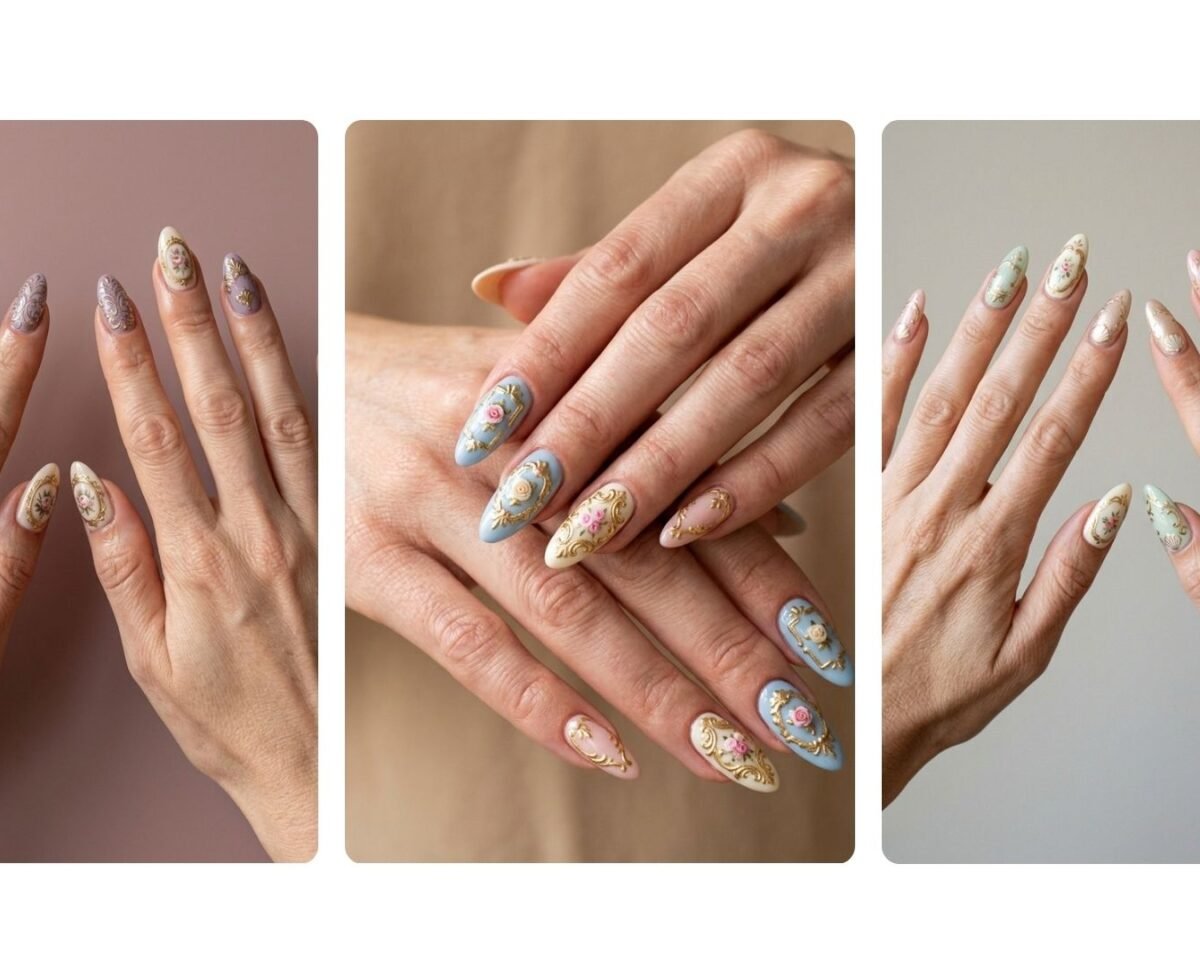
If there’s one manicure trend that proves intricate beauty is making a serious comeback, it’s Rococo Nails. Inspired by the ornate pastel colors decorative style of 18th-century Europe, this aesthetic turns every fingertip into a tiny work of art. Think powdery pastel shades, delicate hand-painted flowers, curling gold ornamentation, antique-inspired frames, porcelain details, romantic garden imagery, and sculptural textures that look almost too beautiful to touch.
What makes this trend especially captivating is the way it combines historical inspiration with modern nail artistry. Instead of literally recreating an antique painting across every finger, nail artists can borrow individual elements from Rococo decorative design and reinterpret them in fresh, wearable ways. A powder-blue manicure can be decorated with raised golden scrolls. An ivory nail can resemble a tiny piece of hand-painted porcelain. Even a simple floral design can take on an entirely different personality when surrounded by an elaborate gilded frame.
There’s also something refreshing about seeing intricate manicures return after years of ultra-minimal beauty. Sheer neutrals, glazed finishes, and barely-there nail art certainly aren’t disappearing, but decorative manicures offer something different: personality. They invite you to look closer and appreciate tiny details that might not be obvious at first glance.
And despite their extravagant inspiration, these designs don’t all need to be dramatic. Some can be surprisingly delicate and wearable. Others embrace the full fantasy with sculpted details and miniature artwork.
Whether you’re drawn to antique interiors, romantic fashion, vintage jewelry, delicate porcelain, or simply beautiful nail art, these ten ideas offer distinctive ways to explore the trend.
Why Rococo Nails Are Taking Over Right Now
Beauty trends are moving toward personality again, and Rococo Nails fit naturally into that shift. Rather than relying on a single viral color or finish, this aesthetic gives nail lovers an entire visual world to explore.
The original Rococo style became known for graceful curves, asymmetrical decoration, floral motifs, shell-inspired ornament, light colors, elaborate interiors, and gilded details. Those characteristics translate remarkably well to nail art because they can be scaled down into tiny scrolls, flowers, borders, medallions, and dimensional accents.
Modern interpretations also connect naturally with several aesthetics already influencing fashion and beauty. Romantic dressing, antique jewelry, corset-inspired details, decorative accessories, vintage interiors, pastel palettes, feminine maximalism, and intricate handcrafted details all share visual similarities with the trend.
But what makes the manicure aesthetic especially interesting is its flexibility.
You don’t need ten heavily decorated nails. One miniature floral painting surrounded by a delicate gold frame can communicate the inspiration beautifully. Someone who prefers subtle manicures could choose an ivory base with thin gilded curves, while a maximalist could combine sculpted flowers, antique frames, pearls, and hand-painted scenes across the entire set.
Color gives you even more freedom. Powder blue and blush pink create a dreamy romantic mood. Ivory feels sophisticated and porcelain-like. Lavender adds whimsy. Mint brings freshness. Champagne and antique gold provide the ornamental richness that makes simpler designs feel special.
If you’re experimenting with the aesthetic at home, starting with a pastel gel nail polish set makes it much easier to build a coordinated palette of powder blue, blush, lavender, mint, and creamy neutral shades without purchasing every color separately.
The goal isn’t to make every nail as complicated as possible. It’s to use thoughtful decorative details that make the manicure feel intentional, artistic, and unmistakably ornate.
Here are ten designs worth saving for your next nail appointment.
1. Powder Blue Rocaille Scroll Nails
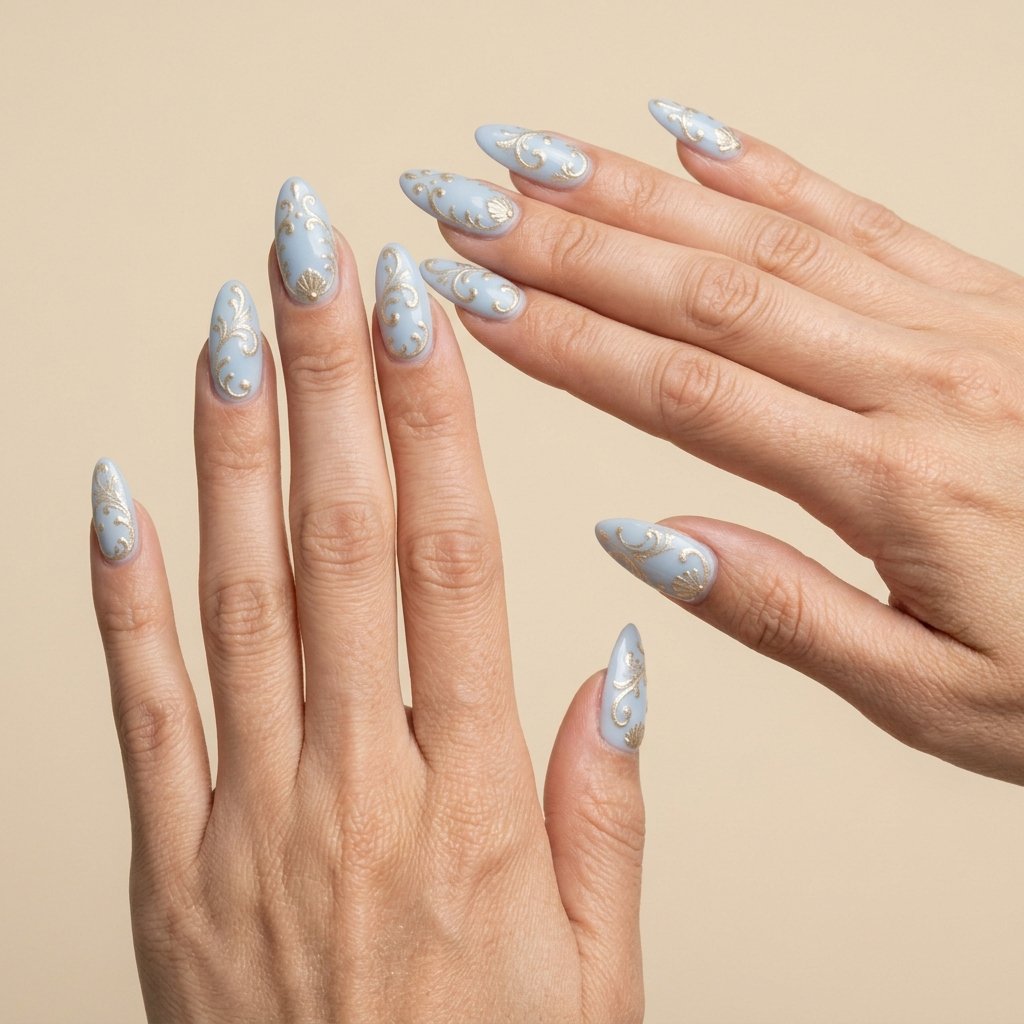
Powder blue provides an ideal starting point for Rococo Nails because it feels soft and romantic while giving metallic ornamentation enough contrast to stand out.
Instead of covering the manicure with conventional flowers or rhinestones, let rocaille-inspired scrollwork become the main feature. Begin with a creamy powder-blue base and introduce fine champagne-gold lines that curl organically across the nails. Some can sweep around the cuticle, while others can curve down one side or form delicate shell-like flourishes.
The important detail is movement.
Rather than creating identical symmetrical patterns, allow the lines to bend and flow differently across each nail. That slight irregularity makes the ornamentation look more artistic and gives the manicure the graceful asymmetry associated with the inspiration.
For additional depth, selected portions of the scrollwork can be created with raised gel. Keeping most of the design flat while lifting only a few curves prevents the manicure from becoming excessively bulky.
A glossy finish works beautifully here because it makes the pastel base appear creamy while catching light across the metallic details.
Style Insight: Keep plenty of powder blue visible between the gold ornamentation. Negative space prevents intricate scrollwork from looking crowded and makes each curved detail easier to appreciate.
Who It Suits: Anyone who loves pastel manicures but wants something more artistic and distinctive than simple solid color.
When to Wear: Spring celebrations, elegant dinners, engagement events, romantic trips, museum dates, or anytime you want a sophisticated statement manicure.
2. Porcelain Garden Panel Nails
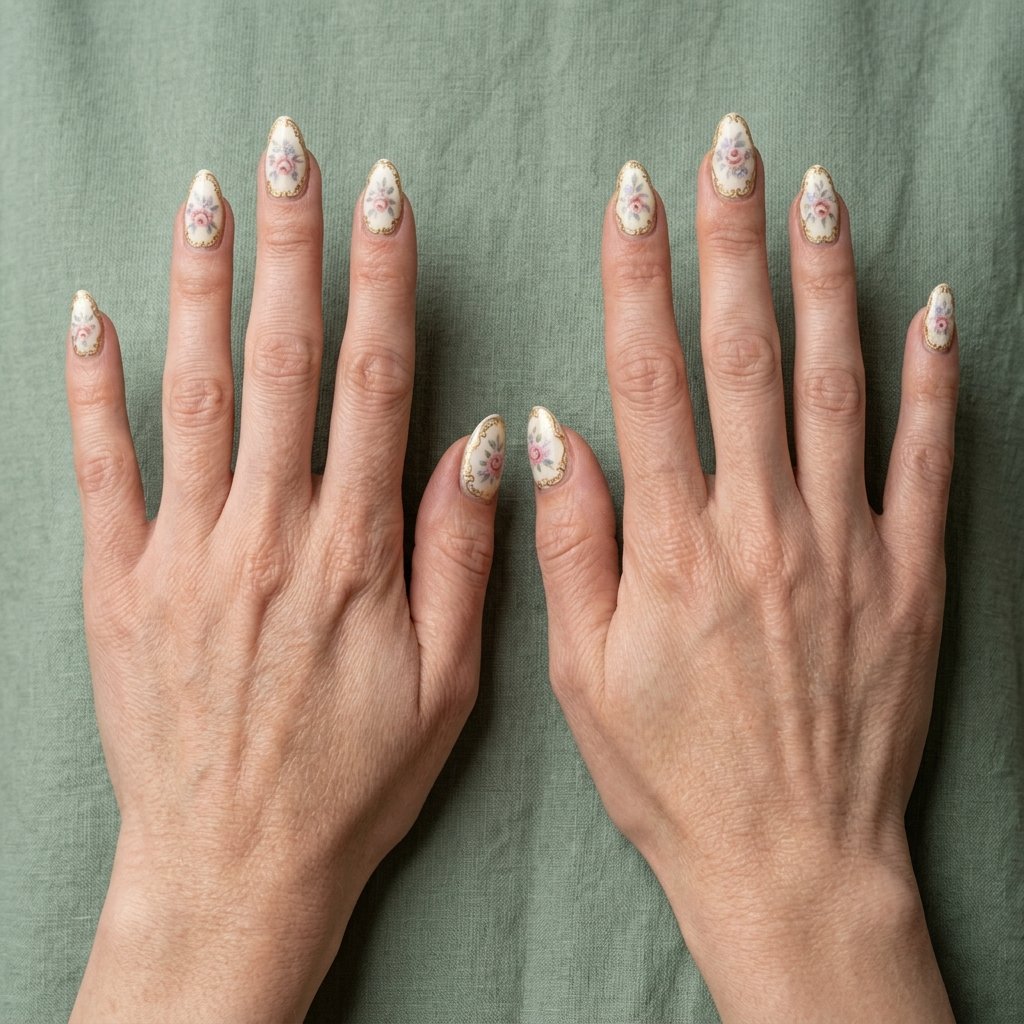
Fine painted porcelain provides some of the most beautiful inspiration for ornate nail art. This design takes that idea and transforms each nail into a miniature decorative panel.
Begin with warm ivory rather than bright white. The slight creaminess gives the base an antique quality and makes the manicure feel softer against the skin. On selected nails, paint tiny botanical arrangements using dusty pink roses, sage leaves, pale lavender flowers, and subtle touches of muted yellow.
The flowers shouldn’t completely cover the nail. Think of them as tiny painted bouquets positioned intentionally within a larger porcelain surface.
Then introduce extremely fine gold borders around selected designs. A thin curved frame can transform a simple floral painting into something that resembles a decorative porcelain panel or antique trinket box.
You can also vary the composition across the manicure. One nail might contain a central bouquet, another could feature a small flower near the corner, and another might remain mostly ivory with only a narrow gilded edge.
For anyone recreating these miniature botanical details at home, using a fine nail art detail brush set can give you much better control over tiny petals, leaves, borders, and narrow decorative lines.
Style Insight: Avoid stark white and overly bright flower colors. Creamy ivory and slightly muted botanical shades create a much more convincing porcelain-inspired finish.
Who It Suits: Lovers of vintage china, botanical artwork, romantic interiors, antique markets, and feminine manicures.
When to Wear: Bridal showers, afternoon weddings, garden parties, spring celebrations, elegant vacations, or sophisticated everyday wear.
3. Antique Cameo Portrait Nails
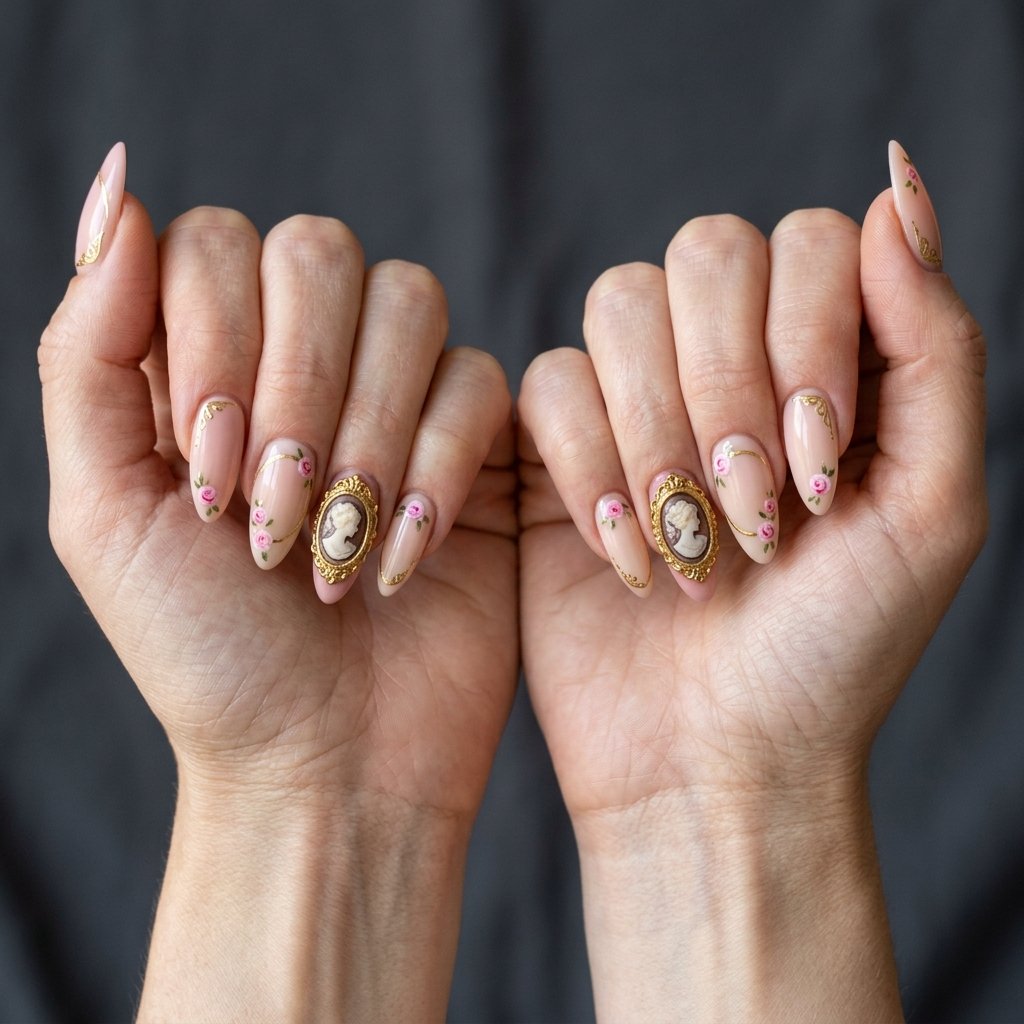
Cameos have an unmistakably antique quality, making them a beautiful starting point for one of the more unusual interpretations of Rococo Nails.
The key is making the manicure feel inspired by miniature jewelry rather than simply placing portrait stickers on every finger.
Start with a blush pink, dusty rose, creamy nude, or pale peach base. On one or two accent nails, create an oval medallion containing a softly painted profile silhouette. Surround the portrait with an intricate antique-gold frame made from fine curved lines and tiny raised flourishes.
The portrait itself doesn’t need photographic detail. In fact, a simplified silhouette or softly painted profile often looks more convincing at such a small scale.
Supporting nails can carry smaller details pulled from the central cameo. Try tiny roses, partial gold frames, fine ornamental corners, or delicate curved borders.
For a more dimensional finish, build the cameo frame slightly above the nail using sculpting gel while keeping the portrait flat underneath. This creates the illusion that a tiny piece of antique jewelry has been embedded directly into the manicure.
Style Insight: Keep the cameo portraits limited to one or two nails. Giving them space makes the intricate artwork feel more luxurious and prevents the set from becoming visually overwhelming.
Who It Suits: Vintage lovers, antique-jewelry enthusiasts, and anyone who prefers nail art that feels genuinely unusual.
When to Wear: Romantic dinners, formal celebrations, vintage-themed events, photoshoots, anniversaries, or occasions when you want people to notice the details.
4. Pastel Sky Fresco Nails
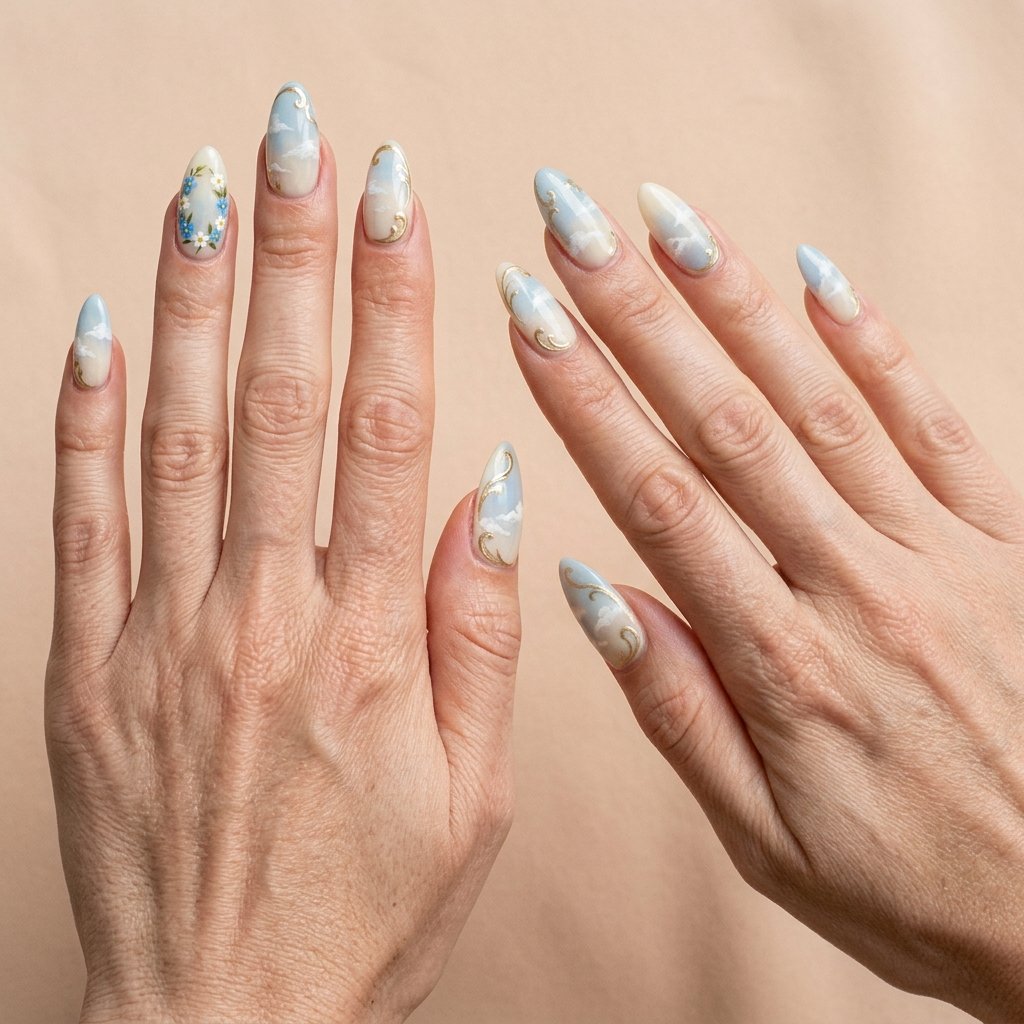
Not every ornate manicure needs flowers as its main attraction. Pastel sky designs offer a dreamy alternative inspired by decorative painted ceilings and romantic frescoes.
Begin with a pale sky-blue base, but don’t leave the color completely flat. Blend soft ivory and slightly deeper blue around different areas to create subtle variation.
Next, paint wispy white clouds using diffused edges rather than crisp cartoon-like outlines. The clouds should appear soft and atmospheric, almost as though they’re disappearing into the background.
Fine champagne-gold ornamentation can frame portions of the sky. Instead of outlining the entire nail, let gilded curves enter from corners or sweep around selected edges. This creates the impression that you’re looking through an elaborate decorative frame toward a painted sky.
One accent nail could include a miniature floral garland floating across the clouds, while another might contain only sky and delicate gold curves.
The finished design should feel painterly rather than graphic.
Style Insight: Use several softly blended shades instead of one solid blue. Tonal variation is what gives the sky depth and prevents the manicure from looking like ordinary cloud nail art.
Who It Suits: Dreamy beauty lovers, art enthusiasts, and anyone who wants a romantic manicure without relying heavily on pink.
When to Wear: Spring vacations, birthdays, creative events, romantic trips, summer celebrations, or whenever you want something ethereal and unexpected.
5. Gilded Shell Motif Nails
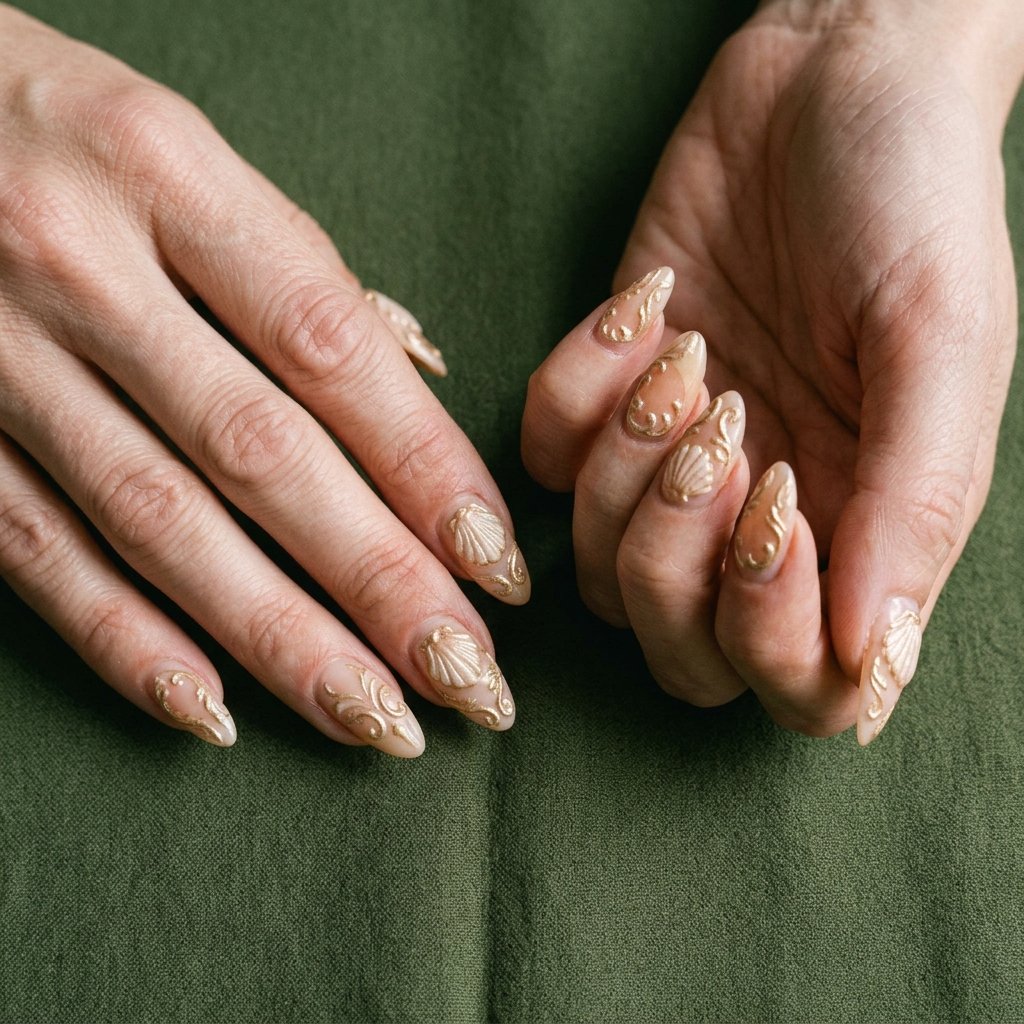
For a design that moves away from the familiar roses-and-ribbons approach, shell-inspired ornamentation offers a distinctive interpretation of Rococo Nails.
Start with a translucent nude, warm cream, or pale peach base. Keeping the background understated allows the dimensional artwork to become the focus.
Using builder or sculpting gel, create small shell-like forms on selected nails. Rather than realistic beach shells, the shapes should feel decorative and stylized, with curling ridges and graceful curves.
Once the sculpted details have cured, highlight their raised edges with champagne or antique gold. The metallic finish catches the light across the ridges, making the ornamentation appear carved and dimensional.
Tiny curling leaves or scroll lines can extend outward from the shells, connecting them visually to the rest of the manicure.
Placement matters here. Instead of centering every shell, position one near a cuticle, another along a sidewall, and another partially extending from the visual edge of the design. Changing the composition keeps the set from feeling repetitive.
If you want to recreate the raised shell ornamentation rather than using bulky charms, a 3D nail sculpting gel gives you more control over the size, curves, and placement of each dimensional detail.
Style Insight: Keep the shell motifs relatively small. The sculptural texture should add sophistication, not make the manicure difficult to wear.
Who It Suits: Nail-art enthusiasts who love dimensional designs but want something less predictable than bows, hearts, or oversized flowers.
When to Wear: Elegant summer events, vacations, formal dinners, fashion occasions, or whenever you want a manicure with subtle sculptural drama.
6. French Palace Mirror Nails
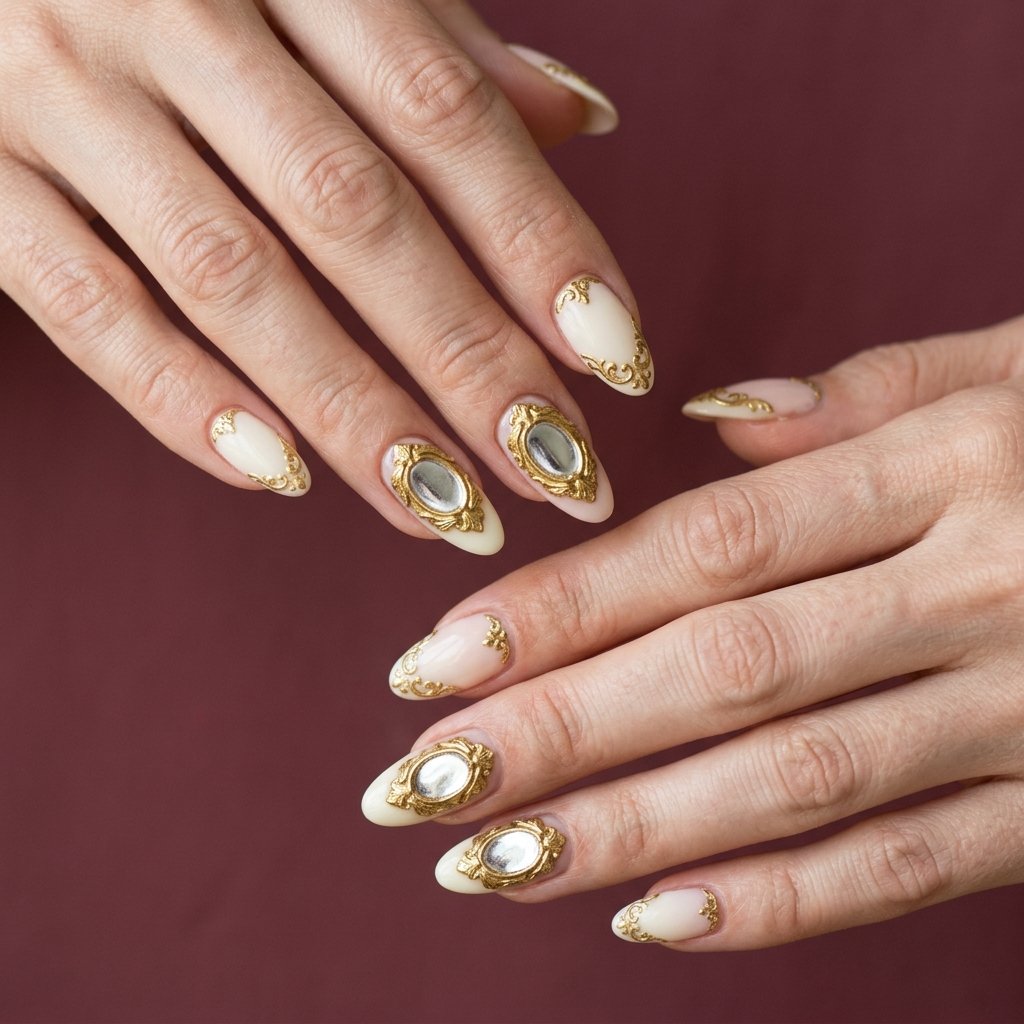
If antique mirrors, gilded frames, and decorative European interiors are your idea of beauty, this design turns those influences into one of the most striking interpretations of Rococo Nails.
The concept begins with a reflective centerpiece. On selected accent nails, use a soft silver chrome finish to create the illusion of a miniature mirror. Instead of covering the entire nail in chrome, keep the reflective section relatively small and surround it with an elaborate antique-gold frame.
The frame is where the design really comes alive. Rather than creating a perfectly even oval or rectangle, use curved edges, tiny leaf-like flourishes, asymmetrical scrolls, and raised ornamental details. The slightly irregular silhouette makes the frame feel much more like antique decoration than modern geometric nail art.
Supporting nails can remain creamy ivory, pale blush, or translucent nude. Add small gold corner details or narrow scrolling borders so they coordinate with the mirror nails without competing for attention.
You could even introduce a slightly aged effect to the reflective center rather than using an ultra-perfect mirror chrome. A softer reflection can make the manicure feel more antique and less futuristic.
The combination of silver and gold may sound dramatic, but the neutral base keeps everything balanced. It also allows both metallic finishes to catch the light differently, giving the manicure dimension from every angle.
Style Insight: Keep the reflective center smaller than the surrounding frame. The ornate border should be part of the focal point rather than simply outlining a large chrome nail.
Who It Suits: Anyone drawn to antique décor, metallic manicures, vintage accessories, and detailed statement nail art.
When to Wear: Evening celebrations, formal dinners, holiday parties, fashion events, birthdays, or occasions where you want an artistic manicure that photographs beautifully.
7. Pastoral Romance Painting Nails
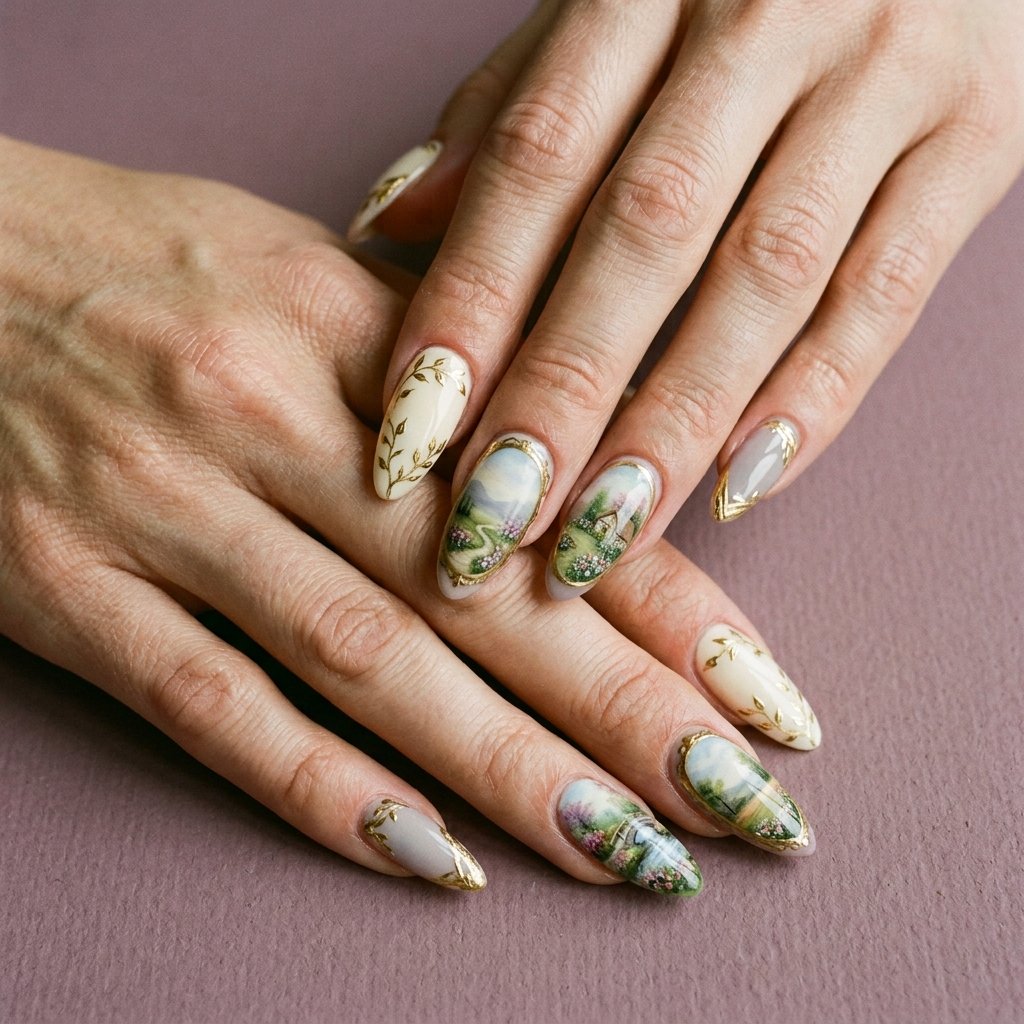
Some manicures use nails as accessories. This design treats them as miniature canvases.
Pastoral painting-inspired nail art takes the romantic landscape imagery associated with decorative historical artwork and reduces it to tiny scenes across selected fingers. Instead of creating sharp, highly detailed illustrations, the goal is to capture atmosphere.
Begin with a creamy ivory or muted pastel base. On feature nails, paint hazy blue skies, distant greenery, small flowering bushes, garden paths, and tiny suggestions of trees. A soft blush sunset or pale golden light can be introduced to give the scene additional warmth.
The artwork doesn’t need to show every leaf or flower. At nail-art scale, loosely blended shapes often look more convincing than extremely sharp details.
One nail could depict a distant garden, another a cloudy sky above greenery, while another might show only a tiny floral landscape enclosed within a gilded border. The remaining nails can stay simpler with fine vines, antique-gold corners, or small painted blossoms.
Adding narrow frames around one or two scenes makes them resemble miniature paintings displayed inside decorative interiors.
A manicure this detailed works particularly well on medium-long or long almond nails because the additional surface provides room for the scenery without forcing every element together.
Style Insight: Use slightly muted colors and soft brushwork. Pastoral artwork should feel atmospheric and romantic rather than like a brightly colored landscape illustration.
Who It Suits: Art lovers, creative personalities, vintage enthusiasts, and anyone searching for a manicure that feels genuinely one-of-a-kind.
When to Wear: Gallery visits, romantic vacations, formal occasions, photoshoots, creative events, or special celebrations.
8. Mint Chinoiserie Rococo Nails
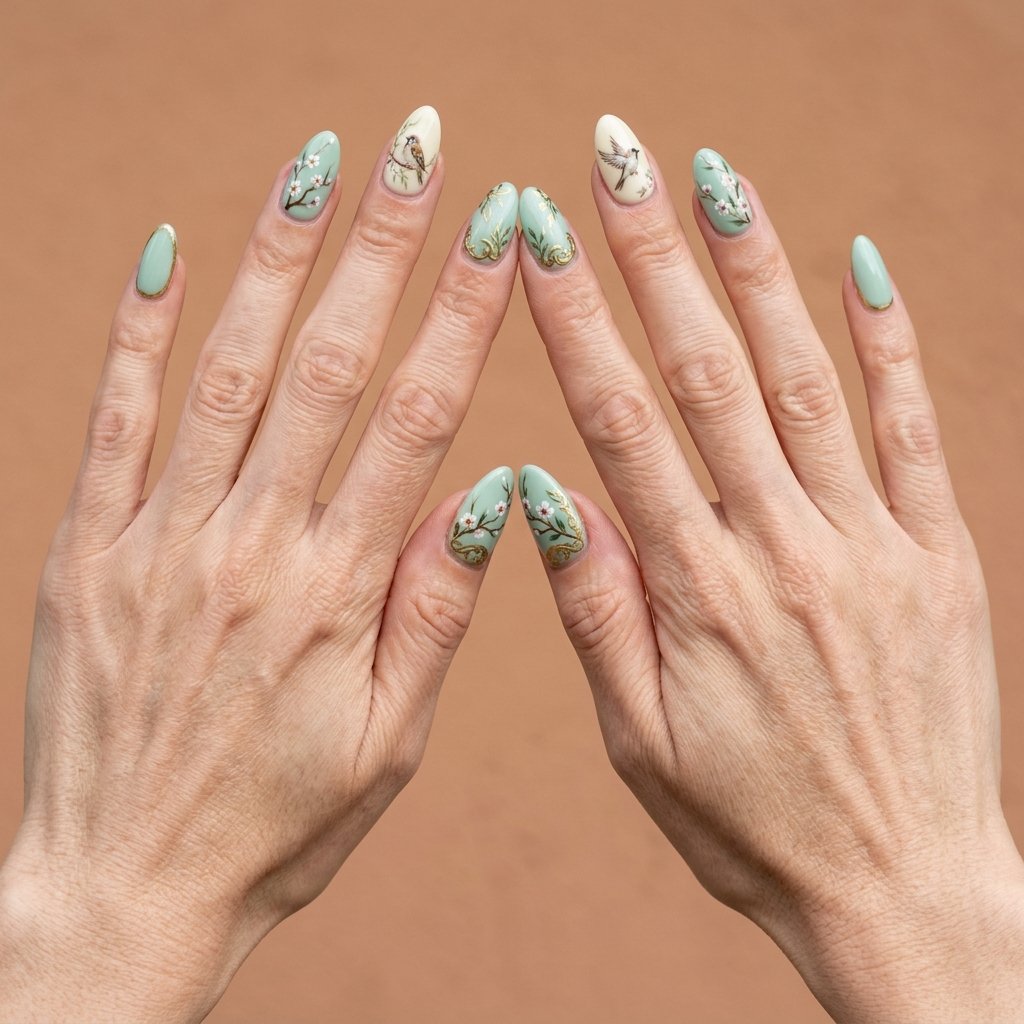
Pink, blue, and ivory naturally dominate romantic historical-inspired manicures, which is exactly why muted mint can make such an interesting alternative.
This design begins with a soft mint-green base that feels almost faded rather than bright or tropical. Across selected nails, paint slender branches decorated with tiny blossoms, delicate leaves, and miniature birds. Small areas of antique gold can then be introduced through borders, curling flourishes, or tiny ornamental accents.
The artwork should remain light and spacious.
Instead of covering all ten nails with complicated illustrations, alternate detailed botanical scenes with simpler mint nails. One might feature a single flowering branch extending diagonally across the surface, while another could carry a tiny bird surrounded by delicate blossoms.
Cream or ivory accent nails can also break up the mint palette and make the hand-painted designs stand out more clearly.
The result feels decorative and collectible, almost like tiny painted panels or ornamental objects translated into manicure form.
For the fine gilded accents used throughout this style, applying small pieces from a gold nail art foil set can create irregular metallic details that look more organic than thick blocks of glitter.
Style Insight: Choose muted sage-mint or pastel mint rather than saturated green. Softer color gives the intricate artwork a more refined, antique-inspired appearance.
Who It Suits: Anyone who enjoys unusual color palettes, botanical nail art, intricate painting, and manicures that don’t look identical to current mainstream trends.
When to Wear: Garden parties, spring celebrations, afternoon weddings, vacations, creative events, or sophisticated everyday styling.
9. Ivory Bas-Relief Floral Nails
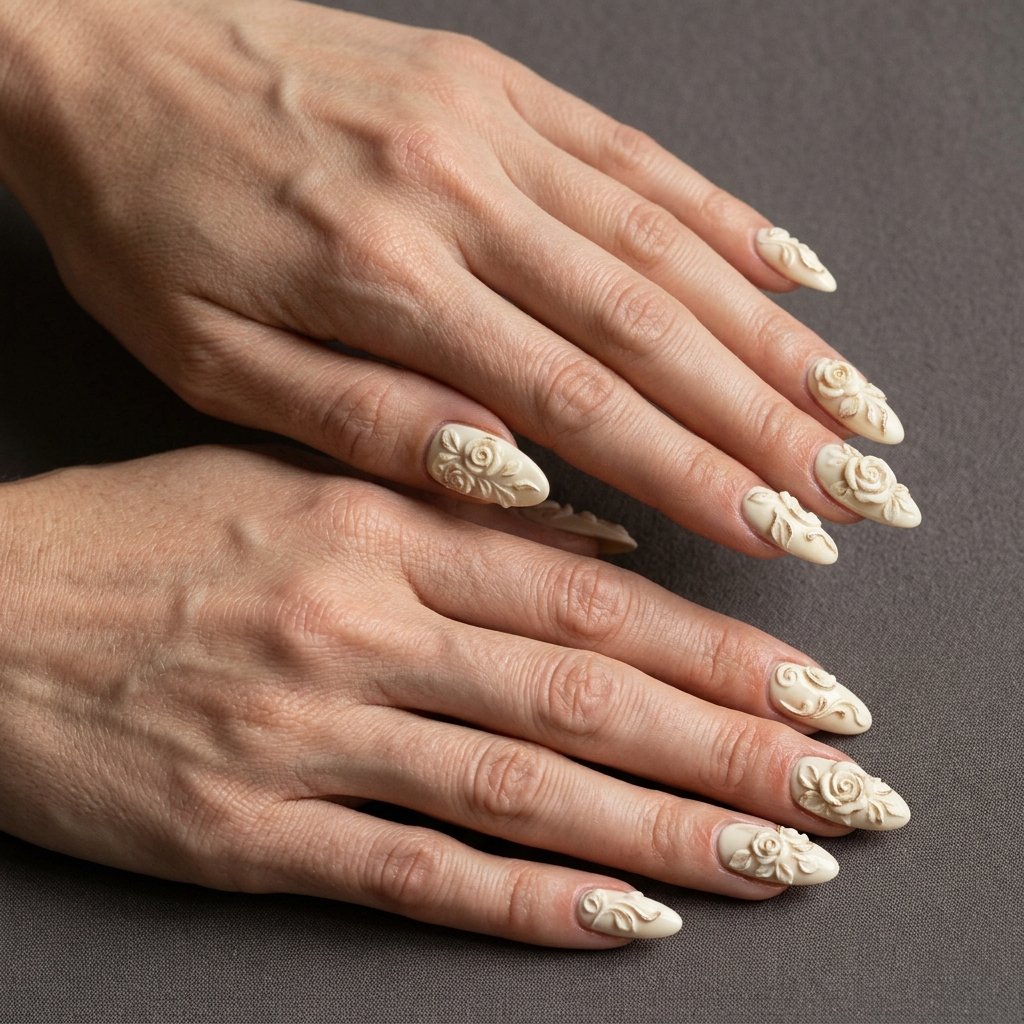
One of the most sophisticated ways to interpret Rococo Nails is to remove almost all the color and allow texture to create the decoration.
Start with a warm ivory base across the entire manicure. Instead of painting colorful flowers over it, sculpt delicate petals, leaves, curved stems, and ornamental flourishes using the same creamy shade.
Because the base and artwork share nearly identical colors, shadows become an important part of the design. Light naturally falls between the raised petals and carved-looking curves, allowing the details to become visible without relying on strong contrast.
Some nails might feature a single raised rose near the cuticle. Others could carry curling leaves along one side, while an accent nail could combine several small flowers into a decorative relief panel.
Keeping some nails relatively simple is particularly important here. If every surface is covered with thick sculptural artwork, the subtle elegance of the monochromatic palette can disappear.
For a slightly more dramatic interpretation, brush the smallest amount of champagne gold over selected raised edges. This should look almost like aged gilding rather than a completely metallic flower.
The final manicure resembles carved plaster, ornamental molding, or delicate ceramic relief work more than conventional floral nail art.
Style Insight: Combine shallow relief with a few more dimensional petals. Varying the height of the artwork creates natural depth while keeping the manicure practical.
Who It Suits: Neutral-nail lovers who want to experiment with ornate details without committing to a colorful maximalist manicure.
When to Wear: Bridal occasions, engagement celebrations, elegant dinners, formal events, winter gatherings, or sophisticated everyday wear.
10. Opulent Rococo Salon Nails
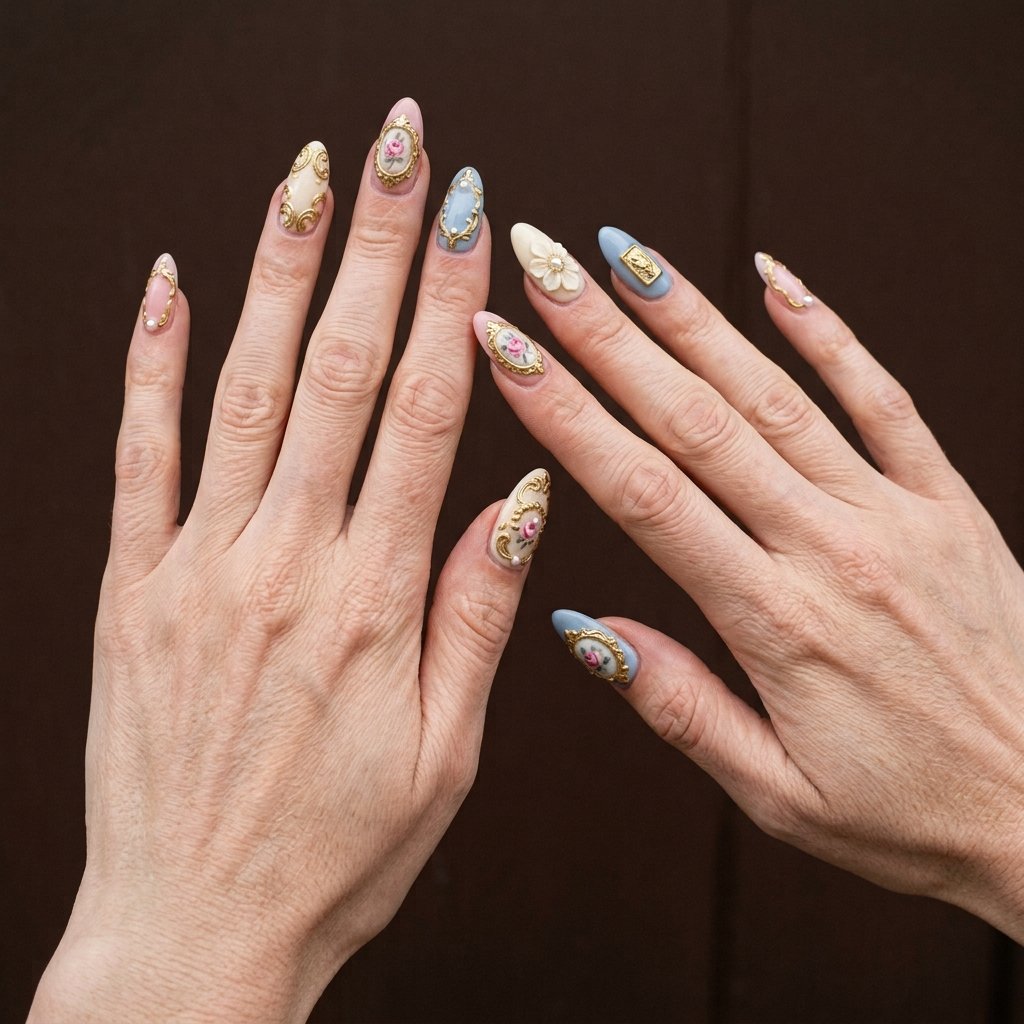
For the final design, restraint takes a back seat.
This is the maximalist version of Rococo Nails, where several decorative ideas come together across one coordinated manicure. Rather than repeating the same design on every finger, imagine the entire set as a collection of details found throughout one extravagant historical interior.
Begin by choosing a controlled palette. Blush pink, powder blue, creamy ivory, and antique gold work beautifully together because they allow every nail to look different while maintaining visual harmony.
One nail could feature raised gold scrollwork over powder blue. Another might display a miniature rose painting inside an elaborate frame. A third could carry ivory sculptural flowers, while another introduces a tiny decorative panel surrounded by gilded curves.
Small pearls can be incorporated between ornamental elements, particularly around frames or floral arrangements. Tiny crystals can also catch the light beautifully, but they should function as finishing details rather than covering the artwork underneath.
If you’re adding dimensional accents, choosing a small pearl and crystal nail embellishment set makes it easier to use delicate pieces that complement miniature artwork instead of overwhelming it.
The secret to making such an elaborate manicure work is repetition through color and material.
For example, if antique gold appears on four or five nails, the eye naturally connects those designs even when their artwork is completely different. Repeating blush flowers or ivory detailing elsewhere creates the same effect.
Nail shape also matters. Long almond nails give scrolling designs an elegant flow, while longer oval and coffin shapes provide plenty of room for miniature frames and sculptural details.
This is not a manicure designed to disappear quietly into an outfit. It becomes part of the outfit.
Style Insight: Decide on three or four recurring colors before choosing individual designs. A consistent palette keeps multiple types of ornamentation looking intentional rather than chaotic.
Who It Suits: Maximalists, nail-art collectors, vintage-fashion lovers, and anyone who treats manicures as an important part of personal style.
When to Wear: Birthdays, major celebrations, luxury vacations, fashion events, photoshoots, holiday occasions, or simply when you want an unforgettable manicure.
Which Rococo Nail Design Matches Your Energy?
The beauty of this aesthetic is that you don’t have to approach it from only one direction.
If your personal style is soft and romantic, porcelain garden panels and pastel sky frescoes offer intricate detail without becoming excessively dimensional. Powder-blue scrollwork provides another beautiful middle ground, especially if you want ornamentation while maintaining a relatively controlled palette.
Those drawn to vintage jewelry and decorative interiors may naturally prefer cameo portraits or palace mirror designs. Both use framing as an important visual element, turning the nails into miniature decorative objects rather than simply painted surfaces.
For something more artistic, pastoral landscapes offer almost unlimited possibilities. Your nail artist could change the scenery, season, color palette, or botanical details while maintaining the same miniature-painting concept.
Texture lovers have equally distinctive options. Gilded shell motifs introduce sculptural ornament without relying on familiar charms, while ivory bas-relief florals create drama almost entirely through shadows and raised surfaces.
And if choosing one detail feels impossible, the opulent salon manicure gives you permission to combine several ideas.
The best Rococo Nails don’t necessarily contain the most decoration. They have a clear visual direction. Choosing a limited palette, repeating a few motifs, and allowing detailed accent nails to breathe can make even elaborate artwork feel carefully considered.
Your nail length can also determine which interpretation works best. Short and medium nails can carry miniature flowers, gold borders, small scrolls, and porcelain details beautifully. Longer almond, oval, square, and coffin shapes provide additional room for framed portraits, landscapes, and dimensional artwork.
Ultimately, choose the element that feels most like you. Historical inspiration should be a starting point, not a rulebook.
How to Keep an Ornate Manicure Looking Luxurious
When you’re combining pastel colors, metallic details, miniature artwork, sculptural gel, and embellishments, it’s surprisingly easy for a manicure to become visually crowded.
A controlled color palette is one of the simplest ways to prevent that.
Choose two primary colors, one neutral, and one metallic accent. Powder blue, ivory, and antique gold make an elegant combination. Blush, cream, and champagne gold create something warmer. Mint, ivory, and muted gold offer a fresher interpretation.
Next, decide which nails deserve the most attention.
If one nail contains a miniature painted landscape surrounded by an ornate frame, the neighboring nail doesn’t necessarily need another complicated painting. A simple ivory base with one curved gold detail can make the elaborate artwork look even more impressive.
Scale is equally important.
Fine lines, miniature flowers, narrow frames, tiny pearls, and controlled sculptural details usually create a more refined effect than oversized embellishments. Large charms can still work, but they should support the overall design rather than hide it.
Consider your lifestyle too. Flat hand-painted ornamentation can capture the aesthetic while remaining relatively easy to wear. Highly raised flowers, frames, and sculptural details are better suited to someone comfortable maintaining dimensional nail art.
Most importantly, don’t confuse maximalism with randomness. Elaborate nail art looks strongest when every decorative choice feels connected.
Choosing the Right Nail Shape
Long almond nails are particularly beautiful for this aesthetic because their tapered shape naturally complements curling vines, elongated frames, floral garlands, and flowing gold ornamentation.
Long oval nails create a similarly romantic effect while providing softer edges.
Coffin and square shapes offer a broader canvas. That additional space can be particularly useful for miniature landscape paintings, cameo portraits, porcelain panels, and larger decorative frames.
Medium nails can still carry plenty of detail. Instead of attempting complete scenes, focus on one or two recognizable elements per nail: a tiny rose, gilded border, shell flourish, miniature frame, or delicate scroll.
Even short nails can embrace Rococo Nails. The key is scaling everything down. A creamy base with tiny painted flowers and narrow gold corners can communicate the aesthetic without requiring long extensions.
Choose your nail shape according to both the artwork you want and the length you’re comfortable maintaining.
Frequently Asked Questions
What are Rococo Nails?
Rococo Nails are manicures inspired by the ornate decorative qualities associated with Rococo art and design. Modern versions often incorporate pastel colors, floral motifs, curved ornamentation, gilded accents, miniature paintings, antique-style frames, sculptural details, and romantic imagery.
They don’t need to reproduce historical artwork literally. Nail artists can borrow individual decorative elements and reinterpret them through contemporary techniques.
What colors are best for a Rococo-inspired manicure?
Powder blue, blush pink, creamy ivory, lavender, pale mint, muted peach, and soft yellow are excellent starting points. Antique gold and champagne metallic finishes work particularly well for scrollwork, frames, borders, and raised ornamentation.
The palette can still be adapted to your personal style. What’s more important is maintaining harmony between the colors and decorative details.
Do Rococo nail designs always need bows and pearls?
No. Bows and pearls can complement the aesthetic, but they aren’t essential.
Shell motifs, asymmetric scrollwork, painted florals, decorative frames, miniature landscapes, cameos, porcelain-inspired artwork, gilded borders, cartouches, and raised relief details can create an even more distinctive interpretation.
Can I wear this nail style on short nails?
Absolutely. Shorter nails simply benefit from smaller-scale artwork.
Try tiny floral clusters, fine gold edges, miniature scrolls, one small framed accent, or delicate porcelain-inspired details instead of attempting a complete landscape on every nail.
Keeping some negative space will also make intricate artwork easier to see.
Are ornate Rococo manicures practical for everyday wear?
They can be, depending on the technique.
Flat painted flowers, pastel bases, fine metallic lines, and delicate borders are easier to maintain than heavily raised embellishments. If you regularly work with your hands, save large sculptural flowers, raised frames, and dimensional decorations for accent nails or special occasions.
Ready to Embrace Rococo Nails?
There’s something wonderfully refreshing about a manicure trend that celebrates detail rather than hiding it. Rococo Nails encourage you to experiment with miniature artwork, graceful curves, dreamy pastels, antique-inspired metallics, and textures that deserve to be viewed up close.
You can keep the aesthetic delicate with porcelain florals and powder-blue scrollwork, explore something artistic through pastel frescoes and miniature landscapes, or embrace full maximalism with sculptural ornamentation, gilded frames, pearls, and carefully coordinated embellishments.
The trend also leaves plenty of room for personal interpretation. You don’t need to recreate a historical artwork perfectly for your manicure to feel inspired by the aesthetic. Sometimes one beautifully painted rose, an asymmetric gold flourish, or a tiny antique-style frame is enough to completely transform a nail.
Save the designs that immediately catch your attention and think about which colors, nail shapes, and level of detail suit your everyday style. Then show your favorites to your nail artist and use them as inspiration for a set that’s uniquely yours.
Whether you choose one ornate accent or transform all ten fingertips into miniature works of art, this is a manicure aesthetic where beautiful details are meant to be noticed.

Hi, I’m Amber, the creator behind Dazzle Me Nails. I started this site because I’ve always believed nails aren’t just about beauty, they’re about confidence, self expression, and feeling put together in the simplest way. Like many of you, I’ve struggled with weak nails, chipped polish, and designs that looked good online but didn’t work in real life. That’s why I created Dazzle Me Nails to share nail ideas that are practical, wearable, and easy to recreate.
Here, you’ll find minimalist nail designs, trend inspired looks, and simple nail care tips to help you achieve clean, polished nails without over complicating your routine. If you love soft, classy, and effortless nail styles, you’re in the right place.